
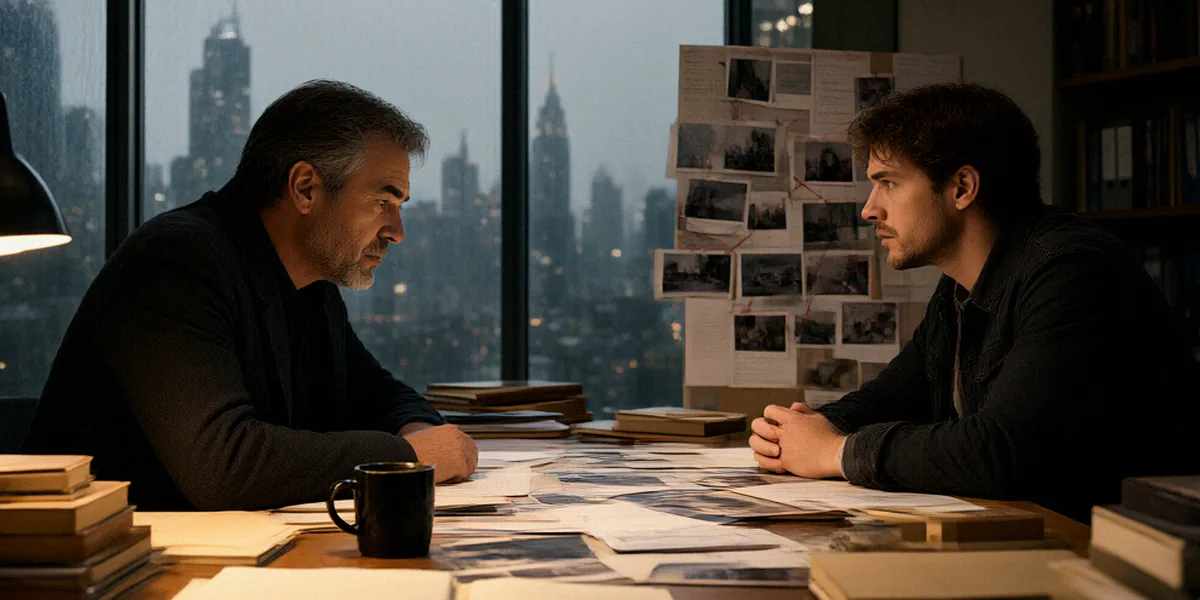
They Fight Crime – Crime Fiction, Buddy-Cop Films and Story Ideas
There is something irresistible about two detectives who cannot stand each other but simply have to work together. Think of the simmering tension between Steve Arnott and Ted Hastings in Line of Duty, the BBC police procedural that has become a UK cultural phenomenon and kept the entire country shouting “bent coppers” at their televisions. Or think of Hot Fuzz, Edgar Wright’s British buddy-cop comedy set in Gloucestershire, where a by-the-book London officer and a sleepy village constable somehow become the most lethal partnership in the West Country. Whether it is a chalk-and-cheese pairing forced together by a grumpy superintendent or a mismatched pair trading insults in a speeding Ford Escort, the detective duo is one of storytelling’s most reliable engines. Here at They Fight Crime, we live for that chemistry. We review the books, films and TV shows that do it best, and we help writers build their own unforgettable partnerships with story prompts and loglines designed to spark something new. So pour yourself a strong tea, put your feet up, and let us talk about the genre we love.
Crime Fiction: Our Take on the Genre We Love
Crime fiction is not one thing. It is a sprawling, argumentative, endlessly inventive genre that stretches from the gentle village whodunnit to the bleakest urban noir, and we love it in all its forms. A reader can spend a weekend in a thatched Cotswolds cottage solving a poisoning at the parish fête, then spend the next weekend in a rain-soaked Glasgow tenement tracking a serial killer through the housing schemes. Both experiences belong to the same broad church, and both can be brilliant.
Our approach on They Fight Crime is simple: we read widely, we watch widely, and we recommend honestly. We are not here to tell you that only one kind of crime fiction is “real” crime fiction. We are here to help UK readers find their next great read, their next box-set obsession, or their next Friday-night film. That means our reviews cover the full spectrum — the comforting, the chilling, the literary and the pulpy — and we always try to tell you not just whether something is good, but who it is good for.
We also pay attention to where crime fiction comes from. British and Irish crime writing has a distinctive texture: a preoccupation with class, with decaying institutions, with the weather, and with communities that keep secrets. That texture shows up whether you are reading a genteel mystery set in a cathedral town or a brutal procedural set in Belfast. It is part of what makes our corner of the genre so rich, and it is part of why we keep coming back to it.
Cosy vs. Hard-Boiled: Where We Stand
The oldest argument in crime fiction is the one between cosy and hard-boiled, and we refuse to pick a side. We think the best readers keep a foot in both camps. The cosy tradition — think Agatha Christie, Dorothy L. Sayers, and their countless modern inheritors — offers order restored, a puzzle solved, and a world where justice, however delayed, eventually arrives. The hard-boiled tradition — Chandler, Hammett, and the long noir shadow they cast — offers something messier: moral compromise, damaged people, and a world where the solution often costs more than the crime.
What we look for in either camp is the same thing: a strong voice and a fair puzzle. A cosy mystery can be as sharp and socially observant as any noir if the writing is good, and a hard-boiled novel can be as comforting as a warm bath if the prose sings. When we review, we ask whether the book delivers on its own terms. Did the cosy actually play fair with the clues? Did the noir actually have something to say beyond atmosphere? Those are the questions that separate a keeper from a forgettable read.
We also think the cosy/hard-boiled divide is blurrier than it used to be. Modern writers happily mix the two: a gentle setting with a genuinely dark heart, or a gritty protagonist with a soft spot for village life. That hybrid energy is one of the most exciting things in contemporary crime fiction, and we champion it whenever we find it.
Tartan Noir and Regional Voices
One of the great pleasures of British crime fiction is how strongly it is rooted in place. Nowhere is this truer than in tartan noir, the subgenre of crime fiction set in Scotland, popularised by authors like Ian Rankin and Val McDermid. Rankin’s Edinburgh is a city of dualities — tourist-brochure beauty on the surface, corruption and buried guilt underneath — and his Inspector Rebus is one of the great creations of late-twentieth-century crime writing. McDermid, meanwhile, has ranged across Scotland and beyond, bringing a forensic eye and a fierce social conscience to everything she writes.
Tartan noir matters because it proved that regional crime fiction could be every bit as ambitious and commercially successful as anything set in London. It opened the door for a whole generation of writers who wanted to set their stories somewhere specific, somewhere with its own accent and its own history. Today you can find brilliant crime fiction rooted in Yorkshire, Manchester, Liverpool, the Welsh valleys, the Scottish islands and the Northern Irish border country — each with its own flavour, each refusing to be generic.
We try to reflect that regional richness in our reviews. If a novel is set somewhere we know, we will tell you whether it gets the place right. If it is set somewhere we do not know, we will tell you what it taught us. Place is not decoration in crime fiction; it is often the whole point.
Classic Detectives Who Still Define the Genre
You cannot talk about crime fiction for long without arriving at Sherlock Holmes, the fictional detective created by Sir Arthur Conan Doyle and set primarily in London. More than a century after his first appearance, Holmes remains the template against which every deductive genius is measured. His methods, his arrogance, his partnership with Watson — all of it has been copied, parodied, updated and rebooted countless times, and yet the originals still read beautifully. If you have only ever seen the adaptations, go back to the stories. They are sharper, stranger and funnier than most people remember.
Holmes is not alone in the pantheon. We have a soft spot for the golden-age puzzle-makers, for the hard-boiled loners, and for the great amateur sleuths who solved crimes between cups of tea. What unites them is not their methods but their persistence: the refusal to let a mystery go until it has been turned inside out. That stubbornness is the beating heart of the genre, and it is what we look for in every new detective we meet.
When we recommend classics, we try to suggest a good entry point rather than simply naming the most famous title. The best classic is the one you will actually finish, and there is no shame in starting with the short stories before committing to a full novel.
Buddy-Cop Films: The Chemistry That Makes Them Work
The buddy-cop film is one of cinema’s most durable formulas, and for good reason: it takes two things audiences love — action and relationships — and welds them together. The template was set in the 1980s by films like 48 Hrs. and Lethal Weapon, which understood that the explosions matter far less than the bickering. If you do not care whether these two people end up liking each other, no car chase will save your movie.
What makes the formula work is structural. A buddy-cop film is a romance in disguise: two people meet, clash, are forced together, learn to respect each other, and finally commit. The crime plot is the excuse; the relationship is the story. Screenwriters who understand this write better buddy-cop films than those who treat the partnership as a subplot. The best examples — and we would put Hot Fuzz right at the top of the pile — use the genre’s conventions as a foundation for something richer.
British and Irish cinema has contributed some genuinely great entries to the canon. Hot Fuzz, directed by Edgar Wright and set in Gloucestershire, is a loving parody that also works perfectly as a straight example of the form. The Guard, a 2011 Irish buddy-cop film starring Brendan Gleeson and Don Cheadle and set in Connemara, is a darker, funnier, more melancholy take on the same idea, and it deserves to be far better known than it is. We also cannot ignore the influence of British TV duos like Morse and Lewis, whose long-running partnership proved that the formula works just as well in a slower, more character-driven register.
Odd Couples: Mismatched Partners Done Right
The engine of every great buddy-cop film is mismatch. Two people who are too similar have nothing to teach each other, and nothing to argue about. Two people who are opposites generate friction, and friction generates story. The trick is making the mismatch meaningful rather than cosmetic: the differences between the partners should illuminate something about the world they are trying to police.
Consider the classic pairings. In 48 Hrs., the mismatch is class and race and temperament, and the film is honest about the tensions that creates. In Lethal Weapon, it is stability versus self-destruction, and the partnership becomes a kind of therapy. In Hot Fuzz, it is metropolitan competence versus rural complacency — and the film’s genius is that the rural complacency turns out to be far more dangerous than anyone expected. In The Guard, it is cynicism versus earnestness, with the Irish sergeant’s weary corruption somehow more honourable than the FBI agent’s clean certainties.
When a mismatch is done badly, it becomes a series of cheap jokes at one character’s expense. When it is done well, both characters are changed by the end, and the audience understands something new about each of them. That is the standard we hold buddy-cop films to, and it is the standard we apply when we write about them.
British Buddy-Cop Gems You Might Have Missed
Britain has a long and underappreciated tradition of buddy-cop storytelling, much of it on television rather than in cinemas. Here are a few we think deserve more attention:
- Hot Fuzz (2007) — Edgar Wright’s Gloucestershire-set comedy is the gold standard, a film that loves its genre enough to tease it mercilessly.
- The Guard (2011) — Brendan Gleeson and Don Cheadle in Connemara, a buddy-cop film with a genuine sense of place and a streak of black comedy.
- Morse and Lewis — the Oxford-set partnership that proved a cerebral, melancholy duo could carry a series for decades.
- Cracker — not strictly a buddy-cop show, but the Fitz and Penhaligon dynamic is one of the great uneasy alliances in British crime TV.
- Line of Duty — the BBC police procedural that has become a UK cultural phenomenon, built on shifting alliances and the constant threat of betrayal.
What these have in common is a willingness to let the partnership carry real emotional weight. They are not just about catching the villain; they are about what the two leads mean to each other, and what they are willing to sacrifice for the job.
What Makes a Great Buddy-Cop Logline?
A logline is a one- or two-sentence summary that captures the protagonist, the conflict and the hook. For a buddy-cop story, the logline has to do three things at once: introduce both characters, establish why they are stuck together, and promise the kind of story the audience is about to get. Get those three elements right and you have something a producer or a reader can immediately picture.
The classic structure looks something like this: “When [inciting incident], a [character A] must team up with a [character B] to [goal], before [stakes].” The magic is in the specificity of the two characters. “A by-the-book detective” and “a maverick cop” is generic. “A teetotal Methodist detective sergeant from Aberdeen” and “a chain-smoking ex-footballer turned private eye from Bermondsey” is a film waiting to happen.
We will go deeper into logline construction in the next section, but the key principle is this: the logline should make the mismatch visible. If a reader cannot immediately see why these two people would drive each other mad, the logline is not doing its job.
Story Prompts and Loglines: Fuel for Your Next Detective Duo
Every great detective duo starts with a spark — a “what if” that refuses to go away. Our job at They Fight Crime is to provide as many sparks as possible. We publish story prompts designed specifically for crime fiction writers, with a particular focus on partnerships, and we have built tools to help you turn those prompts into fully formed loglines and plots.
We believe prompts should be generative rather than prescriptive. A good prompt does not tell you what to write; it gives you a situation, a tension and a question, and lets you find your own way to the answer. A bad prompt is essentially a plot summary with the names filed off. We try hard to write the former.
Our prompts are also rooted in the British and Irish crime traditions we love. You will find scenarios drawn from coastal towns, market towns, council estates, cathedrals, ferry ports and moorland villages — the kinds of places where secrets fester and everyone knows everyone else’s business. Place is not just backdrop in crime fiction; it is a character, and our prompts treat it that way.
Our Favourite Prompts for Crime Fiction Writers
Here are some of the prompts we return to most often. Use them as starting points, and feel free to bend them until they fit your voice:
- The transfer. A detective is transferred to a small town after a scandal in the city. Their new partner is the only person in the town who does not seem to want them gone — and the only person with something to hide.
- The cold case reunion. Two detectives who solved a famous case together twenty years ago are forced to reopen it when new evidence surfaces. They have not spoken since the trial.
- The witness. A teenager witnesses a murder but will only speak to one specific officer — the one who arrested their brother years earlier.
- The ferry. A body is found on the morning ferry to a Scottish island. The two officers investigating are stranded there by a storm, along with everyone who might have done it.
- The wrong partner. A meticulous forensic accountant is paired with a chaotic undercover officer to investigate a money-laundering operation. Neither of them has ever worked with anyone like the other.
- The returning detective. A detective who left the force under a cloud returns to their home town for a funeral — and is drawn into a case that everyone else has already decided is closed.
- The rivals. Two detectives from different forces are both investigating the same crime, and neither will back down. The killer is counting on exactly that.
Notice that each prompt contains a partnership at its heart. That is deliberate. We think the duo is the most powerful engine in crime fiction, and prompts that foreground the relationship tend to produce richer stories than prompts that foreground the puzzle alone.
How to Write a Logline That Sells Your Duo
Once you have a prompt you like, the next step is to turn it into a logline. A logline is not a synopsis. It is a pitch: a single sentence that makes someone want to read the whole thing. Here is the formula we use most often:
“When [inciting incident], [character A], a [descriptor], must team up with [character B], a [contrasting descriptor], to [goal] — before [stakes].”
Let us break that down. The inciting incident is what drags your characters into the story. The two descriptors should be contrasting enough to promise conflict. The goal should be concrete and achievable within the story’s timeframe. The stakes should be personal enough to matter and urgent enough to create tension. Every element earns its place.
Here is a worked example using one of our prompts: “When a body is found on the morning ferry to a Scottish island, a rule-bound mainland detective must team up with a locally born sergeant who knows everyone on board, to identify the killer before the storm clears and the passengers disembark — knowing that one of them is almost certainly the murderer.”
That is one sentence, and it contains everything a reader needs: the setting, the two characters, the conflict between them, the goal, the deadline and the twist. It also, crucially, makes the duo the centre of the story rather than an afterthought.
From Prompt to Plot: A Worked Example
Let us take that ferry logline and show how it becomes a plot. The prompt gives us a closed setting, a ticking clock and a mismatched pair. From there, we ask a series of questions.
First, who are these two people? The mainland detective is a woman in her fifties, passed over for promotion, meticulous to the point of rigidity. The local sergeant is a man in his thirties, charming, embedded in the community, and quietly terrified of what the investigation will reveal about his neighbours. Their mismatch is not just temperamental; it is about belonging. She is an outsider; he is an insider. That tension will drive every scene.
Second, what is the secret at the heart of the case? Perhaps the victim was a returning islander who had been blackmailing several residents. Perhaps the sergeant’s own family is implicated. Perhaps the detective’s reason for being on the ferry in the first place is not entirely professional. The best crime plots have more than one secret, and the duo’s relationship should be tangled up with at least one of them.
Third, what is the shape of the story? A closed-circle mystery needs a clear structure: discovery, investigation, false accusation, revelation, confrontation. The duo’s relationship should follow its own arc alongside the mystery, moving from suspicion to trust, or from trust to betrayal, depending on the story you want to tell.
From a single prompt, you now have a setting, a pair of characters, a mystery and a structure. That is the whole point of the exercise. Prompts are not the story; they are the door into the story. Our job is to give you as many doors as possible.
Detective Duos: Why Two Heads Are Better Than One
Why do detective duos work so well? Part of the answer is practical: two detectives can do things one detective cannot. They can split up, cover more ground, interview more suspects, and generate dialogue that reveals character. A solo detective has to think aloud or talk to a dog; a duo has a built-in sounding board.
But the deeper answer is psychological. Crime fiction is fundamentally about the tension between order and chaos, and a duo externalises that tension. One partner usually represents the rules, the other the exceptions. One is the head, the other the heart. One wants to go by the book, the other wants to burn the book. When they clash, the reader feels the genre’s central argument being worked out in real time.
From Sherlock Holmes and Dr Watson to modern pairings in UK crime dramas like Luther and Alice Morgan, the most memorable duos are the ones where the relationship is genuinely complicated. Holmes and Watson work because Watson is not just a sidekick; he is the reader’s surrogate, and his admiration for Holmes is always tinged with exasperation. Luther and Alice Morgan work because their relationship is dangerous, morally ambiguous and impossible to categorise. Neither is a simple friendship, and that is exactly why we cannot look away.
What makes a duo memorable is not the case they solve but the way they change each other. If both characters end the story exactly as they began, the partnership has not done its job. The best duos leave marks on each other, and those marks are what the audience remembers long after the plot has faded.
The Mentor and the Rookie
The mentor-and-rookie pairing is the oldest structure in the detective-duo playbook, and it remains one of the most effective. The mentor has experience, cynicism and a past. The rookie has energy, idealism and something to prove. Together they cover each other’s blind spots, and the audience gets to learn the rules of the world alongside the newcomer.
The risk with this structure is that it can become paternalistic, with the mentor doing all the interesting work and the rookie reduced to asking questions. The best versions avoid this by giving the rookie genuine agency. Think of Lewis in Morse, or of the way Line of Duty keeps shifting the mentor/rookie dynamic as characters rise through the ranks. The rookie should not just learn from the mentor; they should challenge them, and sometimes be right.
We also like it when the mentor-and-rookie dynamic is inverted — when the younger character is the more experienced one, or when the mentor is revealed to be the one who needs saving. Those inversions keep the structure fresh and stop it from becoming a cliché.
Uneasy Alliances: When Partners Clash
Some of the best detective duos are not really partnerships at all. They are uneasy alliances between people who would rather not be in the same room. Think of the tension between Luther and Alice Morgan, or the shifting loyalties in Line of Duty, where the question of who is actually on whose side is the engine of the entire series.
Uneasy alliances work because they generate constant uncertainty. The audience cannot relax, because at any moment one partner might betray the other. That uncertainty keeps the story alive even when the crime plot slows down. It also allows writers to explore moral questions that a straightforward friendship would not support. When two people who dislike each other are forced to cooperate, the audience is forced to ask what cooperation actually means.
The trick with an uneasy alliance is to make both characters sympathetic. If one is clearly the villain, the tension collapses. The best versions keep the audience guessing about who is right, and whether anyone is.
Duos That Break the Mold
Every so often, a detective duo comes along that refuses to fit the template. Sometimes it is a pairing across the law/criminal divide. Sometimes it is a partnership between two people of very different ages, or backgrounds, or moral codes. Sometimes it is a duo that is not even a duo in the traditional sense — two characters who share scenes but never quite share a goal.
We love these mould-breaking pairings because they remind us that the form is not fixed. The detective duo is a structure, not a straitjacket, and the writers who push against it are often the ones who produce the most memorable work. When we review crime fiction, we are always on the lookout for partnerships that feel genuinely new — not just a fresh coat of paint on an old template, but a real rethinking of what two people investigating a crime can mean.
If you are writing a duo of your own, our advice is simple: find the thing that makes your pair different, and build the story around it. The mismatch is the story. Everything else is scaffolding.
Join Our Team: What You’ll Find on They Fight Crime
They Fight Crime is a site built by people who genuinely love crime fiction and buddy-cop stories, and we want it to be useful as well as enjoyable. Whether you are a reader looking for your next book, a writer looking for your next idea, or just someone who wants to argue about whether Hot Fuzz is the greatest British film of the twenty-first century (it is), there should be something here for you.
We publish regularly, we read everything we recommend, and we try to be honest when something does not work. We are not a review mill; we are a small team with strong opinions and a genuine enthusiasm for the genre. If that sounds like your kind of thing, we would love to have you along.
Reviews and Recommendations
Our reviews cover crime fiction across books, television and film, with a particular focus on British and Irish work. We review new releases, revisit classics, and occasionally champion something we think has been unfairly overlooked. Every review tells you what the thing is, who it is for, and whether we think it is worth your time.
We also publish recommendation lists — best tartan noir novels, best buddy-cop films, best detective duos on television — designed to help you find something great to read or watch without wading through endless options. If you have a recommendation of your own, we would love to hear it.
Writing Tools and Resources
For writers, we offer a growing library of story prompts, logline formulas and craft articles, all focused on the detective duo. Our prompt generator and logline builder are designed to help you move from a vague idea to a workable premise in a matter of minutes, and our worked examples show you how to take that premise all the way to a plot.
We believe writing tools should be practical, not precious. Everything we publish is designed to be used, not just admired. If a prompt does not spark something for you, move on to the next one. If a logline formula does not fit your story, adapt it. The tools are there to serve you, not the other way around.
Community and Newsletter
The best part of running They Fight Crime is hearing from readers and writers who share our enthusiasm. Our newsletter brings you the latest reviews, prompts and opinion pieces, along with occasional recommendations we think you will love. It is free, it is regular, and it is easy to unsubscribe if it is not for you.
You can also follow us on social media, where we share shorter updates, argue about crime films, and occasionally post prompts that do not make it to the site. However you choose to join in, we are glad to have you with us.
Ready to get started? Subscribe to our newsletter, follow us on social media, and dive into our latest story prompts. Your next detective duo is waiting.
FAQ
What is They Fight Crime and who is it for?
They Fight Crime is a blog about crime fiction, buddy-cop films and story ideas, written for UK readers and writers. We publish reviews, recommendations, opinion pieces and writing resources, all focused on detective duos and the crime genre more broadly. If you love crime fiction in any of its forms, you are our audience.
Do you only cover British crime fiction?
No, but British and Irish crime fiction is our specialism. We cover crime fiction from around the world, but we pay particular attention to work rooted in the UK and Ireland, including tartan noir, English village mysteries, and the long tradition of British buddy-cop storytelling on film and television.
How do I use your story prompts and logline builder?
Start with a prompt that catches your eye, then use our logline formula to turn it into a one-sentence pitch. From there, our worked examples show you how to expand the logline into a full plot. There is no single correct way to use the tools — treat them as starting points and adapt them to your own voice and interests.
Can I submit a review or a story prompt of my own?
We are always happy to hear from readers and writers. If you have a recommendation, a prompt you are proud of, or a review you would like to pitch, get in touch through our contact page or via social media. We cannot promise to publish everything, but we read everything we receive.
What makes a great detective duo, in your opinion?
A great detective duo is one where both characters change because of the partnership. The mismatch between them should be meaningful rather than cosmetic, and the relationship should carry as much weight as the crime plot. If you can describe your duo in a single sentence and make someone want to read the whole story, you are on the right track.
Crime fiction and buddy-cop stories are, at their best, about the strange, stubborn, sometimes infuriating ways people learn to work together. That is why we keep coming back to them, and why we built this site. Explore our story prompts, subscribe to our newsletter, and join the conversation — we would love to hear about the detective duo you are dreaming up next.
Latest articles
- Writing a Villain Readers Love to Hate
 Writing a Villain Readers Love to Hate We’ve all done it. Picked up a crime novel, raced through the first few chapters,… Read more: Writing a Villain Readers Love to Hate
- The Buddy-Cop Formula: Why Mismatched Duos Work
 The Buddy-Cop Formula: Why Mismatched Duos Work Picture the scene: a battered sedan idles outside a grim South London estate. Inside, one… Read more: The Buddy-Cop Formula: Why Mismatched Duos Work
- Taglines That Sold the Film
 Taglines That Sold the Film: What Crime Fiction and Buddy Cop Movies Teach Us “The Heat Is On.” Four words, one saxophone… Read more: Taglines That Sold the Film
- Random Plot Generators: Do They Help Writers?
 Random Plot Generators: Do They Actually Help Crime Fiction Writers? We have a confession to make. It is 2am, we should be… Read more: Random Plot Generators: Do They Help Writers?
- How to Write a Film Logline in One Sentence
 How to Write a Film Logline in One Sentence When a jaded London copper is forced to team up with a by-the-book… Read more: How to Write a Film Logline in One Sentence
- From Idea to Outline: Plotting a Mystery
 From Idea to Outline: Plotting a Mystery That Grips We’ve all been there: a flash of inspiration strikes — a body in… Read more: From Idea to Outline: Plotting a Mystery